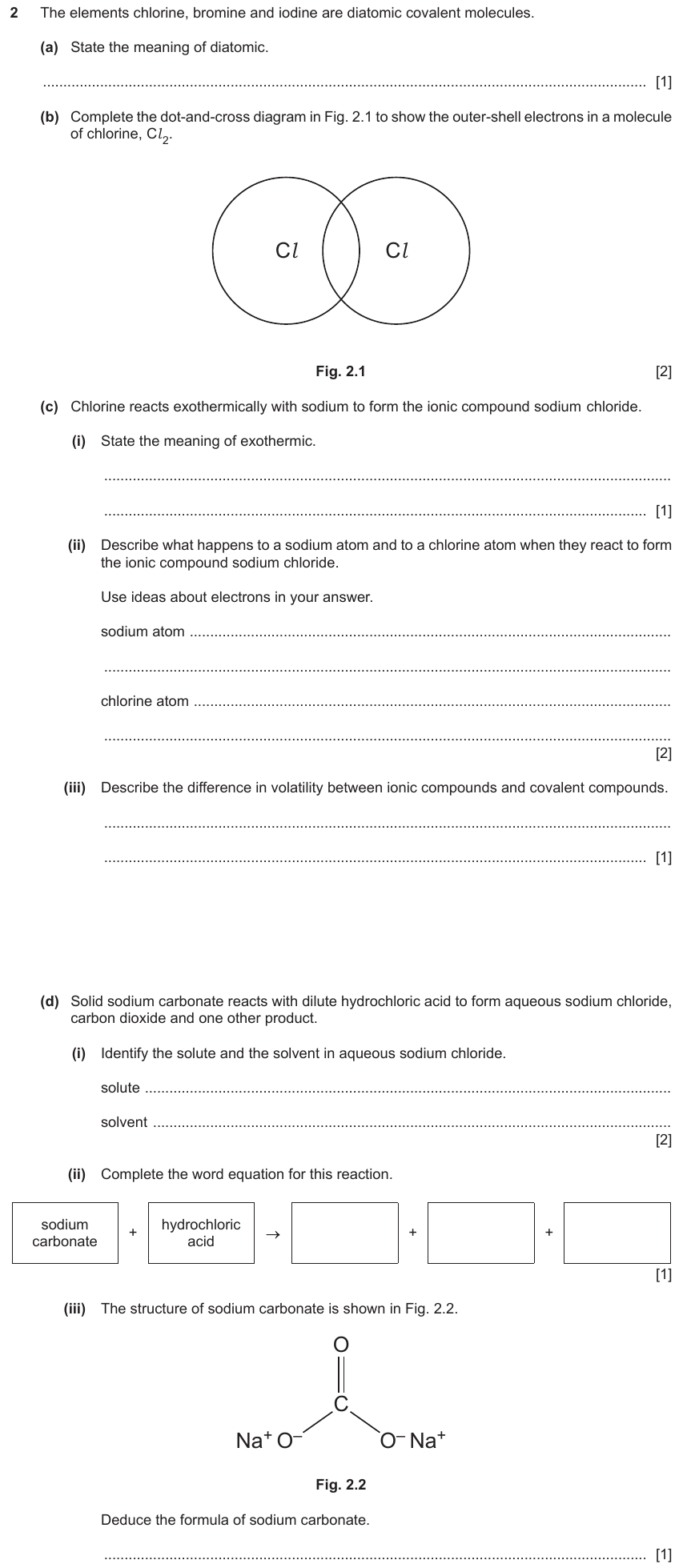
Exercise 1 — IGCSE 0653 May/Jun 2024 Paper 31 Q2
Show mark scheme
(molecule containing) two atoms (chemically combined)
Moles = mass (g) ÷ molar mass (g/mol)Moles = volume (dm³) × concentration (mol/dm³)Moles of gas at RTP = volume (dm³) ÷ 24 (at room temperature and pressure)% yield = (actual yield ÷ theoretical yield) × 100% purity = (mass of pure substance ÷ total mass) × 100Empirical formula: simplest whole-number ratio of atoms. Molecular formula: actual ratio.1 Cambridge IGCSE 0653 Combined Sciences past paper questions on stoichiometry, across Theory, Multiple Choice and Alternative to Practical.
Stoichiometry uses the mole concept to calculate the quantities of reactants and products in chemical reactions. Students must be able to calculate percentage composition, empirical formulae and reacting masses.
What's covered:
| Type | Level | Paper | Session | Q# | Marks | Answer / key |
|---|---|---|---|---|---|---|
| Theory | Core | Paper 31 | May/Jun 2024 | Q2 | 11 marks | (molecule containing) two atoms (chemically combined) |