Gravitational force: F = Gm₁m₂/r² (Newton's law of gravitation)
Orbital speed: v = 2πr/T (circumference ÷ period)
Key facts & rules
Solar system: Sun (star) → 8 planets → moons, asteroids, comets.
Planets orbit the Sun due to gravitational attraction — centripetal force provided by gravity.
Geostationary orbit: period = 24 h, above equator, always above same point — used for communications.
Low Earth orbit: period ~90 min, lower altitude — used for weather satellites, ISS.
Life cycle of a star: nebula → protostar → main sequence (most of its life) → red giant/supergiant → white dwarf (small star) OR supernova → neutron star or black hole (large star).
Red-shift: galaxies moving away show longer wavelength light — evidence for expanding universe.
Big Bang theory: universe began ~13.8 billion years ago from a single point; has been expanding since.
1 light-year: distance light travels in 1 year ≈ 9.46 × 10¹⁵ m.
IGCSE Physics — Space Physics
13 Cambridge IGCSE 0653 Combined Sciences past paper questions on space physics, across Theory, Multiple Choice and Alternative to Practical.
About Space Physics on IGCSE 0653
Space physics explores the solar system, stars and the universe. Gravitational forces keep planets in orbit. Stars form from nebulae and end their lives in different ways depending on their mass.
What's covered:
The solar system: planets, moons, comets, asteroids
Gravitational field and orbital motion
The life cycle of a star
Red-shift and evidence for the Big Bang
The expanding universe
Satellites: natural and artificial orbits
Light-years and distances in space
Theory
Papers 3 & 4 · 1 questions · Structured written questions with mark scheme answers.
Space Physics — Extended1 · Paper 4
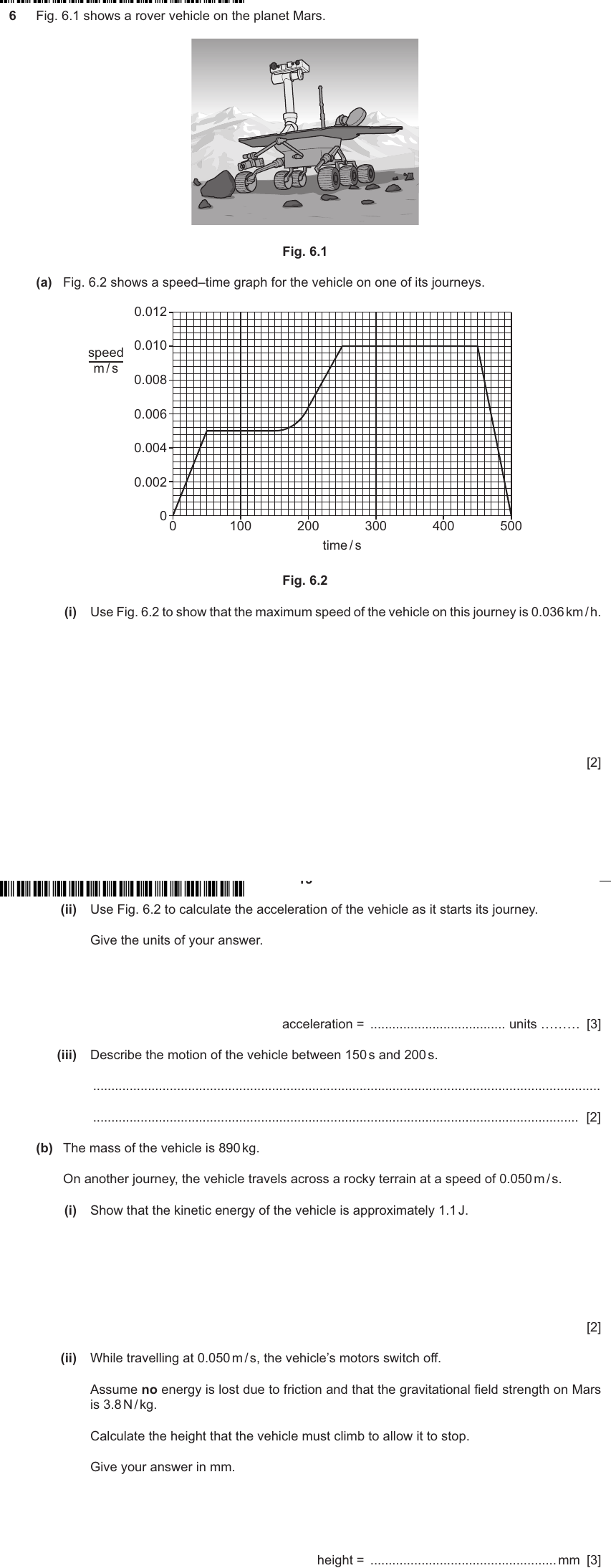
Exercise 1 — IGCSE 0653 May/Jun 2024 Paper 42 Q6
Cambridge past paperExtended12 marksPaper 42May/Jun 2024