IGCSE Practice

Cambridge IGCSE·Co-ordinated Sciences 0654·Physics Kinetic Particle Model Of Matter
📋Key knowledge — Thermal Physics

Formulas & equations

  • Thermal energy = mass × specific heat capacity × temperature change (Q = mcΔT)
  • Pressure × Volume = constant (Boyle's law, constant temperature)
  • P/T = constant (pressure law, constant volume)
  • V/T = constant (Charles' law, constant pressure)
  • Combined gas law: PV/T = constant

Key facts & rules

  • Conduction: energy transfer through a solid via vibrating particles/free electrons — metals are best conductors.
  • Convection: energy transfer in fluids — heated fluid rises (less dense), cool fluid sinks.
  • Radiation: energy transfer by infrared waves — no medium needed; black/dull surfaces best emitters and absorbers.
  • Specific heat capacity (SHC): energy needed to raise 1 kg of a substance by 1 K (or 1°C).
  • Latent heat: energy needed to change state WITHOUT temperature change.
  • Temperature in Kelvin: T(K) = T(°C) + 273.
  • Gas laws: temperature must be in KELVIN.
  • Thermal expansion: most substances expand when heated; used in thermostats, bimetal strips.

IGCSE Physics — Kinetic particle model of matter

1 Cambridge IGCSE 0654 questions on kinetic particle model of matter, across all three components.

About kinetic particle model of matter on IGCSE 0654

Every Cambridge IGCSE Co-ordinated Sciences 0654 question on kinetic particle model of matter (Thermal physics, Physics), across all three exam components. Theory and alternative-to-practical come with full mark schemes; multiple choice is interactive — click an option to check it.

Multiple choice

Papers 1 & 2 · 1 question · Click an option (A–D) to check your answer instantly.
Kinetic particle model of matter — Extended multiple choice questions1 total · Paper 2

Exercise 1 — IGCSE 0654 May/June 2025 Paper 21 Q31
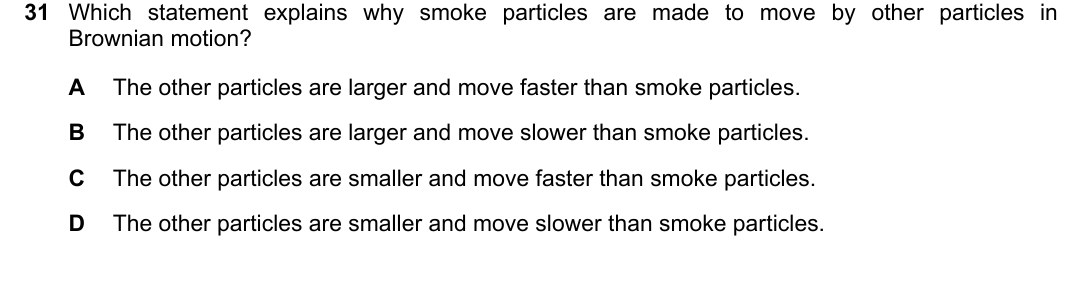
Cambridge past paperExtended1 mark Paper 21May/June 2025
IGCSE 0654 May/June 2025 Paper 21 Question 31 — Kinetic particle model of matter
Show answer
Correct answer: C
↑ Back to top

More Thermal physics subtopics