Cambridge IGCSE·Combined Sciences 0653·BiologyMovement In Out Of Cells
📋Key knowledge — Movement In Out Of Cells
Key facts & rules
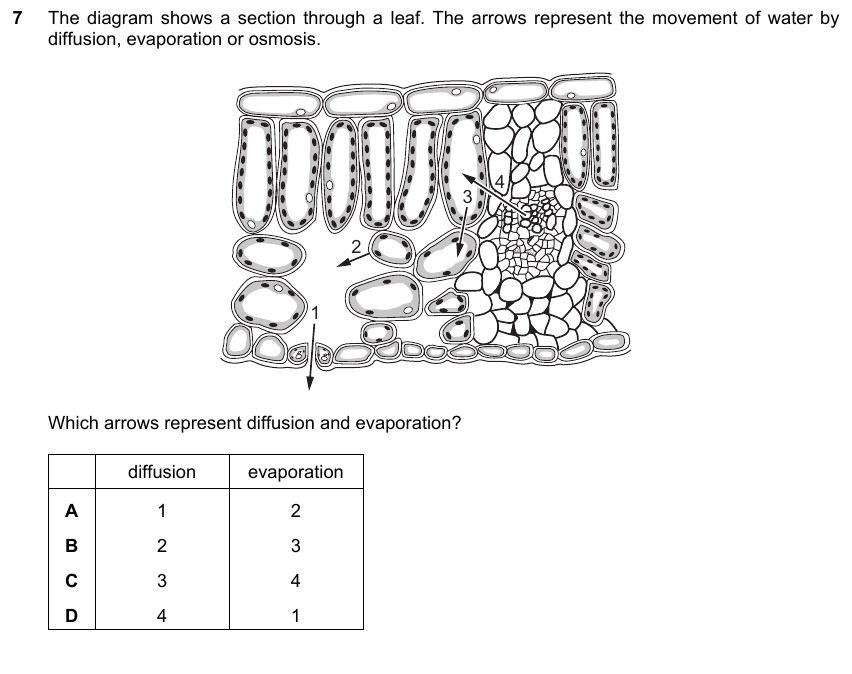
Diffusion: net movement of particles from HIGH to LOW concentration — no energy needed (passive).
Osmosis: net movement of WATER molecules from high water potential (dilute solution) to low water potential (concentrated solution) through a selectively permeable membrane — passive.
Active transport: movement from LOW to HIGH concentration — requires ENERGY (ATP) and carrier proteins.
Turgid cell: full of water, firm (plant cells in dilute solution).
Plasmolysed cell: loses water, membrane pulls away from cell wall (plant cells in concentrated solution).
Crenated/shrunken: animal cells in concentrated solution (they have no cell wall).
IGCSE Biology — Movement in/out of Cells
2 Cambridge IGCSE 0653 Combined Sciences past paper questions on movement in/out of cells, across Theory, Multiple Choice and Alternative to Practical.
About Movement in/out of Cells on IGCSE 0653
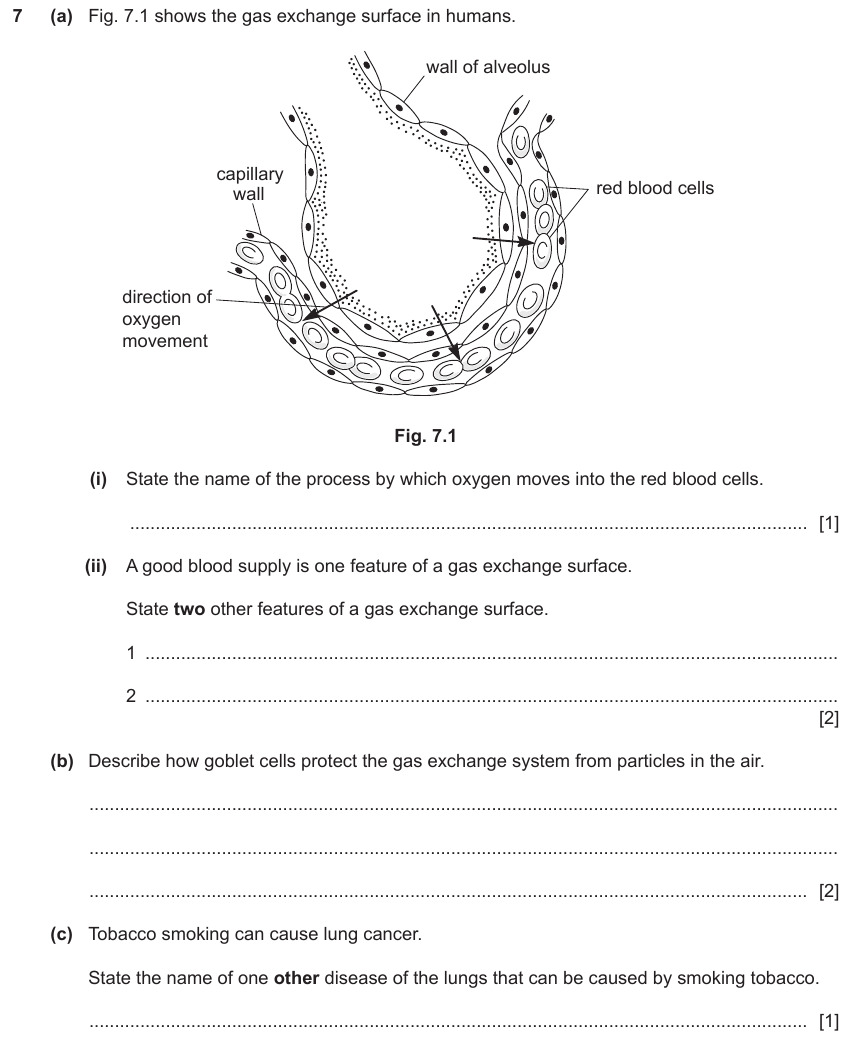
Substances move in and out of cells by diffusion, osmosis and active transport. This topic is essential for understanding how oxygen enters blood cells, how water moves through plants, and how mineral ions are absorbed by roots.
What's covered:
Diffusion: definition and examples
Osmosis: water potential and semi-permeable membranes
Active transport: moving substances against concentration gradients
Turgid, flaccid and plasmolysed cells
Theory
Papers 3 & 4 · 1 questions · Structured written questions with mark scheme answers.
Movement in/out of Cells — Extended1 · Paper 4
Exercise 1 — IGCSE 0653 May/Jun 2023 Paper 42 Q7
Cambridge past paperExtended6 marksPaper 42May/Jun 2023