IGCSE Practice

Cambridge IGCSE·Co-ordinated Sciences 0654·Chemistry Diffusion
📋Key knowledge — States Of Matter Particles

Key facts & rules

  • Solid: particles close together in a regular lattice, vibrate in fixed positions.
  • Liquid: particles close together but random arrangement, free to move past each other.
  • Gas: particles far apart, random, move rapidly in all directions.
  • Melting: solid → liquid (at melting point). Boiling: liquid → gas (at boiling point).
  • Condensation: gas → liquid. Freezing/Solidification: liquid → solid. Sublimation: solid → gas directly.
  • Kinetic theory: particles are always moving; higher temperature = higher average kinetic energy.
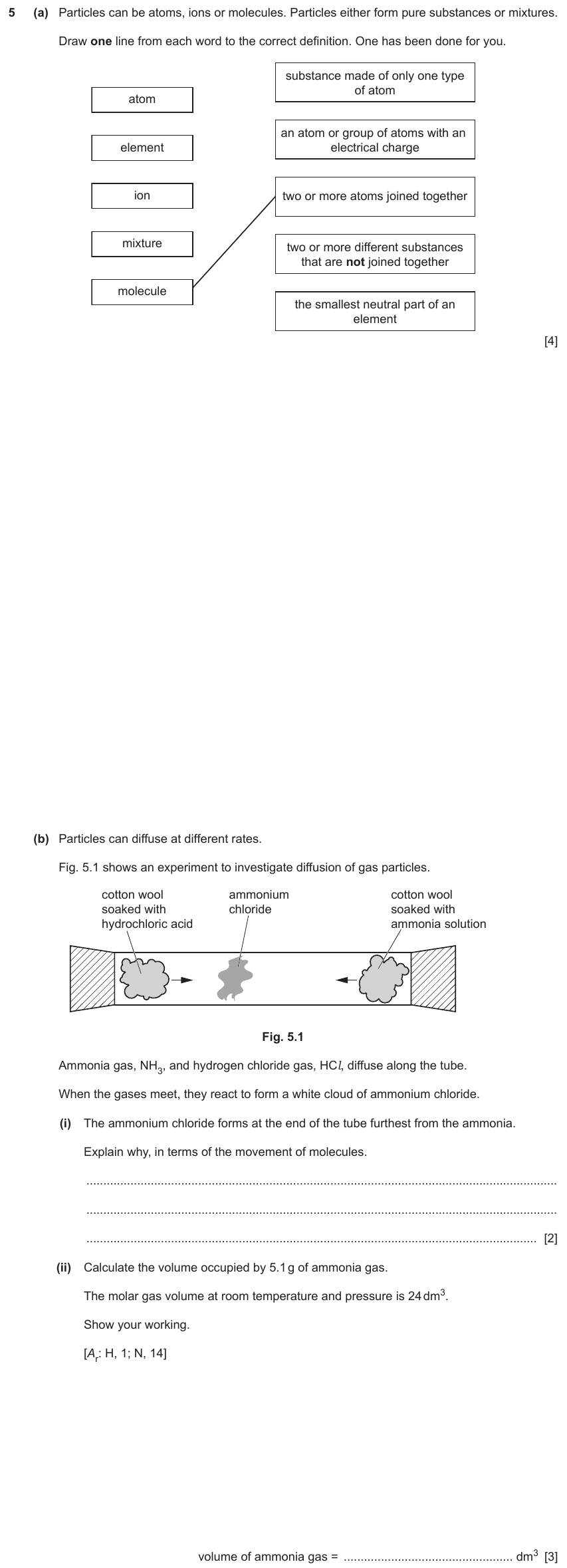
  • Diffusion: particles spread from high to low concentration. Faster in gases than liquids.
  • Brownian motion: random movement of particles in a fluid, caused by collisions with invisible molecules.

IGCSE Chemistry — Diffusion

1 Cambridge IGCSE 0654 questions on diffusion, across all three components.

About diffusion on IGCSE 0654

Every Cambridge IGCSE Co-ordinated Sciences 0654 question on diffusion (States of matter & particles, Chemistry), across all three exam components. Theory and alternative-to-practical come with full mark schemes; multiple choice is interactive — click an option to check it.

Theory

Papers 3 & 4 · 1 question · Structured written questions, each with its full mark scheme.
Diffusion — Extended theory questions1 total · Paper 4

Exercise 1 — IGCSE 0654 Nov 2023 Paper 43 Q5
Cambridge past paperExtended9 marks Paper 43Nov 2023
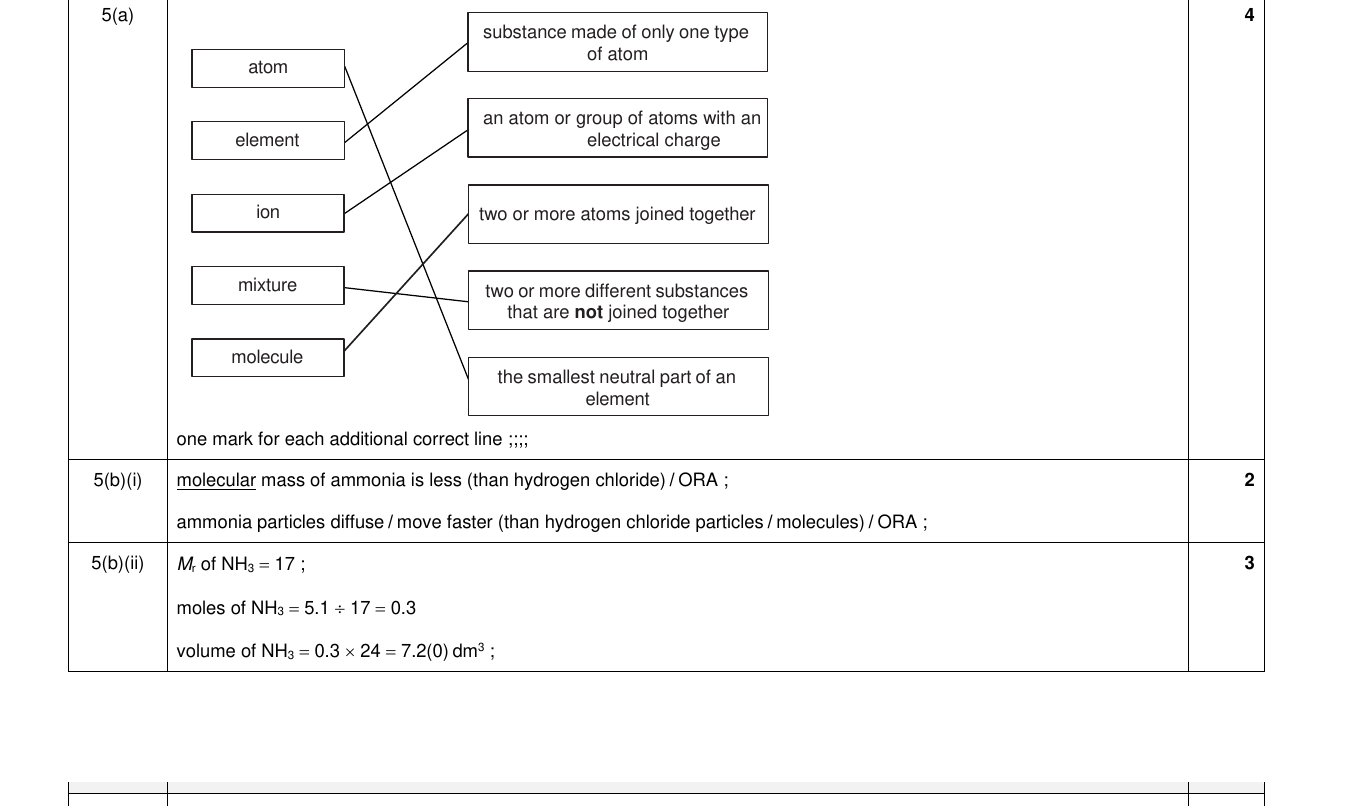
IGCSE 0654 Nov 2023 Paper 43 Question 5 — Diffusion
Show mark scheme
Mark scheme for IGCSE 0654 Nov 2023 Paper 43 Q5
↑ Back to top

More States of matter & particles subtopics