IGCSE Practice

Cambridge IGCSE·Co-ordinated Sciences 0654·Chemistry Metallic Bonding
📋Key knowledge — Chemical Bonding

Key facts & rules

  • Ionic bonding: metal loses electrons (→ cation) + non-metal gains electrons (→ anion) → electrostatic attraction.
  • Ionic compounds: high melting point, conduct electricity when dissolved or molten, form crystals.
  • Covalent bonding: non-metals share pairs of electrons.
  • Simple molecular: low melting/boiling point, do NOT conduct electricity (e.g. H₂O, CO₂, CH₄).
  • Giant covalent: very high melting point, hard, do NOT conduct electricity (except graphite). E.g. diamond, SiO₂.
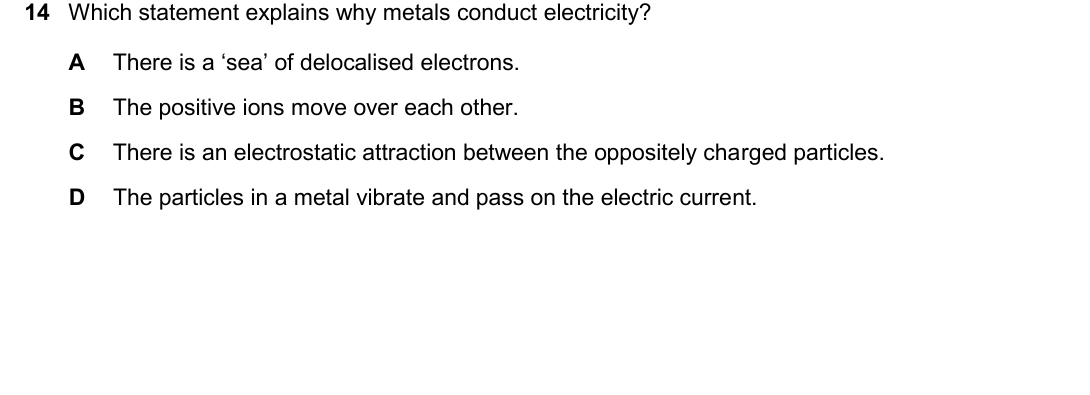
  • Metallic bonding: lattice of positive ions surrounded by a 'sea' of delocalised electrons.
  • Metals: conduct electricity/heat, malleable, ductile — because of delocalised electrons.
  • Hydrogen bonds: strong intermolecular forces in water and between N−H/O−H groups.
  • Van der Waals forces: weak, temporary dipole attractions — exist between ALL molecules.

IGCSE Chemistry — Metallic bonding

1 Cambridge IGCSE 0654 questions on metallic bonding, across all three components.

About metallic bonding on IGCSE 0654

Every Cambridge IGCSE Co-ordinated Sciences 0654 question on metallic bonding (Chemical bonding, Chemistry), across all three exam components. Theory and alternative-to-practical come with full mark schemes; multiple choice is interactive — click an option to check it.

Multiple choice

Papers 1 & 2 · 1 question · Click an option (A–D) to check your answer instantly.
Metallic bonding — Extended multiple choice questions1 total · Paper 2

Exercise 1 — IGCSE 0654 May/June 2025 Paper 22 Q14
Cambridge past paperExtended1 mark Paper 22May/June 2025
IGCSE 0654 May/June 2025 Paper 22 Question 14 — Metallic bonding
Show answer
Correct answer: A
↑ Back to top

More Chemical bonding subtopics