IGCSE Practice

Cambridge IGCSE·Co-ordinated Sciences 0654·Chemistry Preparation Of Salts
📋Key knowledge — Acids Bases Salts

Formulas & equations

  • acid + metal → salt + hydrogen
  • acid + metal oxide → salt + water
  • acid + metal hydroxide → salt + water (neutralisation)
  • acid + metal carbonate → salt + water + carbon dioxide

Key facts & rules

  • Acid: produces H⁺ ions in solution. pH < 7.
  • Alkali: produces OH⁻ ions in solution. pH > 7. (Bases that dissolve in water.)
  • Neutralisation: H⁺ + OH⁻ → H₂O.
  • pH scale: 0–14. pH 7 = neutral. Strong acids have lower pH than weak acids at same concentration.
  • Strong acid: fully dissociates (HCl, H₂SO₄, HNO₃). Weak acid: partially dissociates (CH₃COOH).
  • Making insoluble salts: mix two solutions containing the required ions → filter the precipitate.
  • Making soluble salts: add excess solid acid/metal/metal carbonate to acid → filter → evaporate.
  • Titration: used to find exact volume of acid/alkali needed for neutralisation.

IGCSE Chemistry — Preparation of salts

2 Cambridge IGCSE 0654 questions on preparation of salts, across all three components.

About preparation of salts on IGCSE 0654

Every Cambridge IGCSE Co-ordinated Sciences 0654 question on preparation of salts (Acids, bases & salts, Chemistry), across all three exam components. Theory and alternative-to-practical come with full mark schemes; multiple choice is interactive — click an option to check it.

Multiple choice

Papers 1 & 2 · 2 questions · Click an option (A–D) to check your answer instantly.
Preparation of salts — Extended multiple choice questions2 total · Paper 2

Exercise 1 — IGCSE 0654 May/June 2025 Paper 22 Q24
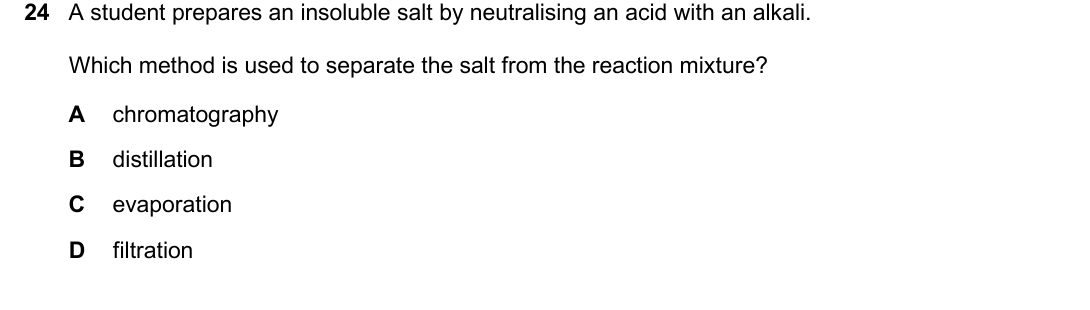
Cambridge past paperExtended1 mark Paper 22May/June 2025
IGCSE 0654 May/June 2025 Paper 22 Question 24 — Preparation of salts
Show answer
Correct answer: D

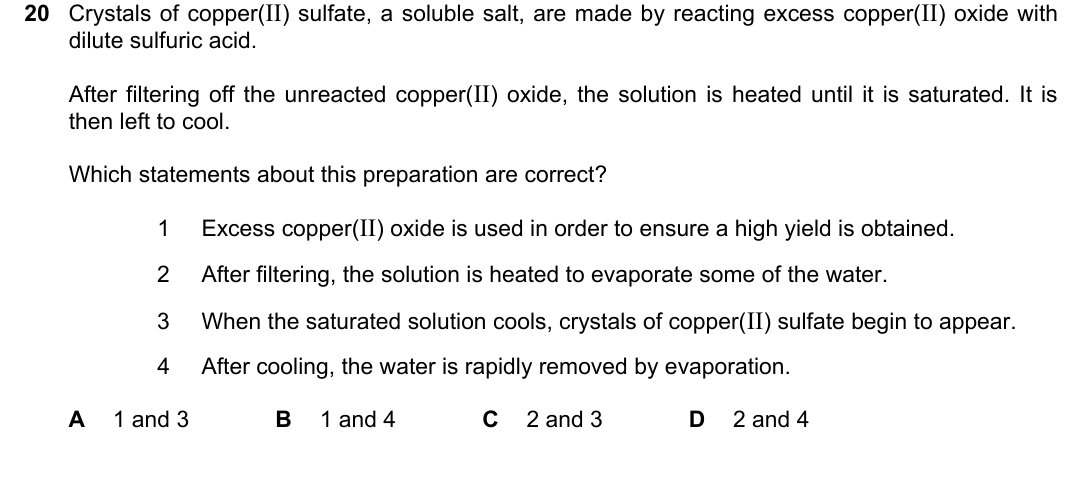
Exercise 2 — IGCSE 0654 May/June 2023 Paper 23 Q20

Cambridge past paperExtended1 mark Paper 23May/June 2023
IGCSE 0654 May/June 2023 Paper 23 Question 20 — Preparation of salts
Show answer
Correct answer: C
↑ Back to top

More Acids, bases & salts subtopics